

PFAS-Free Food Packaging: What Foodservice Buyers Should Check Before Bulk Procurement
• Start with the applicable legal or customer requirement, not a generic “PFAS-free” logo.
• Match analytical evidence to the exact finished SKU, material structure and manufacturing site.
• Use a “no intentionally added PFAS” statement as supporting evidence, not as a substitute for testing where testing is required.
• Control later changes to fiber, barrier chemistry, coating, lamination, ink, lid or production site before releasing recurring orders.
For EU food-contact packaging, Regulation (EU) 2025/40 (PPWR) sets PFAS concentration limits from 12 August 2026: 25 ppb for any targeted PFAS, 250 ppb for the sum of targeted PFAS, and 50 ppm for PFAS including polymeric PFAS under the Regulation’s defined conditions. For procurement teams, that means the evidence must relate to the actual product being placed on the market.
Do Not Use an Arbitrary Test-Report Expiry Rule
The original article treated reports older than twelve months as automatically unreliable. A better rule is to ask whether the tested construction still matches the product being ordered. Re-testing may be appropriate when the fiber source, barrier formulation, coating supplier, ink, lamination, lid, manufacturing site or other relevant characteristic changes, or when a buyer, regulator or certification scheme requires new evidence.
This change-control approach is more useful than relying only on report age. It also prevents a common sourcing mistake: approving a clean development sample while allowing later mass-production substitutions to occur without technical review.
What “No Intentionally Added PFAS” Does - and Does Not - Prove
A “no intentionally added PFAS” declaration is useful because it addresses formulation intent: the supplier states that fluorinated chemicals are not deliberately used in the product recipe. It does not, by itself, provide a measured concentration for the finished package or prove compliance with every market threshold.
For EU-bound food-contact packaging, procurement teams should therefore combine formulation information with the analytical evidence needed for the applicable PPWR thresholds. For other markets or customer programs, the required test method and acceptance criteria may differ. Keeping the declaration and laboratory evidence separate makes the approval file easier to audit and reduces the risk of treating one document as universal proof.
Use Production-Representative Samples for Verification
Testing is strongest when the laboratory sample represents the structure that will actually be produced at scale. Buyers should record the SKU, manufacturing site, production or sample date, material revision and any barrier, coating, ink or lid configuration associated with the tested item. For higher-risk or high-volume programs, an agreed reference sample can also be retained by both buyer and factory so later production can be compared with the approved construction.
Independent laboratory testing may be required by the destination market, customer specification or internal procurement policy. The important point is not to create a ritual in which every shipment is re-tested regardless of risk, but to define clear triggers for re-testing and to preserve traceability between the analytical result and the commercial order.
A useful PO or quality agreement can state who selects the sample, which laboratory or method is acceptable, which result criteria apply, and what happens if a material or process change is proposed after approval.
Separate PFAS Evidence From Other Compliance Claims
PFAS verification, food-contact compliance and compostability are related procurement topics, but they are not interchangeable. A BPI or OK compost certificate supports compostability only within its certified scope. BRCGS Packaging Materials relates to site-level quality and product-safety systems. amfori BSCI is a social-compliance audit framework. Food-contact reports address the intended contact conditions and destination-market requirements.
For a buyer, the practical rule is simple: ask which document proves which requirement. Do not accept a long certificate list as a substitute for a product-level PFAS file.
Grizzlies Supports PFAS-Free Solutions Across Its Full Bagasse Tableware Range
Grizzlies supports PFAS-free sourcing across its full bagasse tableware portfolio and can supply PFAS-free product options for plates, bowls, trays, clamshells, food containers, cups and lids. The company combines 15+ years of OEM/ODM manufacturing experience with 11 production bases, 280+ automated machines and capacity of up to 200 × 40HQ per month, giving high-volume buyers one manufacturing platform for multi-SKU PFAS-focused programs.
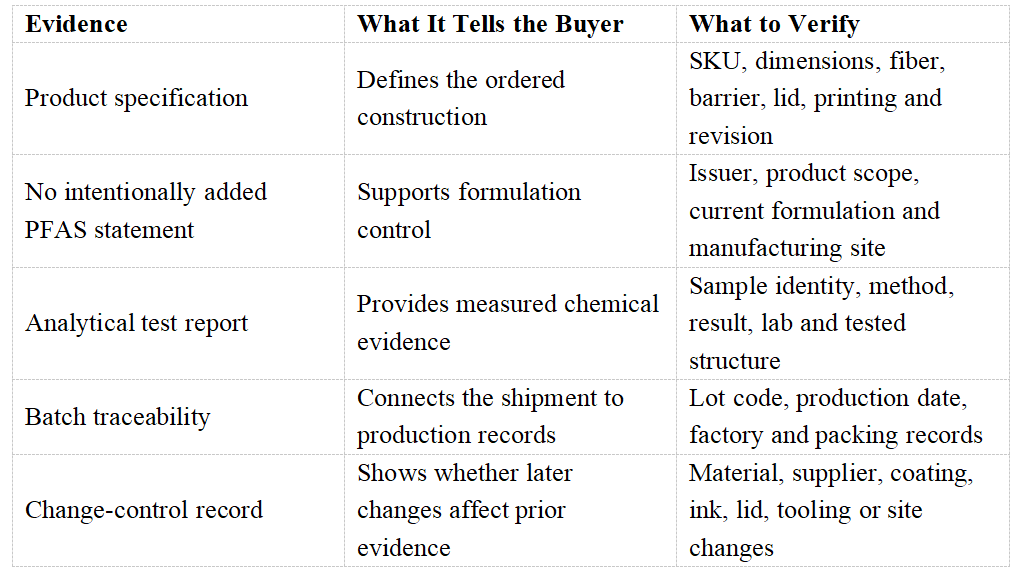
For each selected SKU, Grizzlies can coordinate the relevant product specification, no-intentionally-added-PFAS statement, analytical test evidence and batch-traceability records required by the buyer or destination market. This makes it possible to combine product development, PFAS documentation, sample approval, quality control and recurring bulk production within the same supplier program.
Buyer Check Before PO Release
• Confirm the exact SKU and revision covered by the PFAS evidence.
• Match the test sample to the actual coating, lamination, ink and lid configuration.
• Record the manufacturing site and batch-traceability method.
• Define which material or supplier changes require buyer approval or document reassessment.
• Keep PFAS, food-contact and compostability evidence in separate, clearly identified parts of the approval file.
Procurement managers can send the target product, expected volume, destination market and required evidence to the Grizzlies team to request product specifications, samples and a factory-direct quotation before a bulk order is released.
Shenzhen Grizzlies Industries Co.,LTD
Shenzhen Grizzlies Industries Co.,LTD
+ +86 137 1519 2986
email us here
Legal Disclaimer:
EIN Presswire provides this news content "as is" without warranty of any kind. We do not accept any responsibility or liability for the accuracy, content, images, videos, licenses, completeness, legality, or reliability of the information contained in this article. If you have any complaints or copyright issues related to this article, kindly contact the author above.
