

Global 3D-Printed Food Market Led by North America, Key Players Nestlé, Barilla, Natural Machines Growth Boom
3D-Printed Food Market accelerates with tech innovation, customization demand, and sustainable food solutions shaping future consumption.
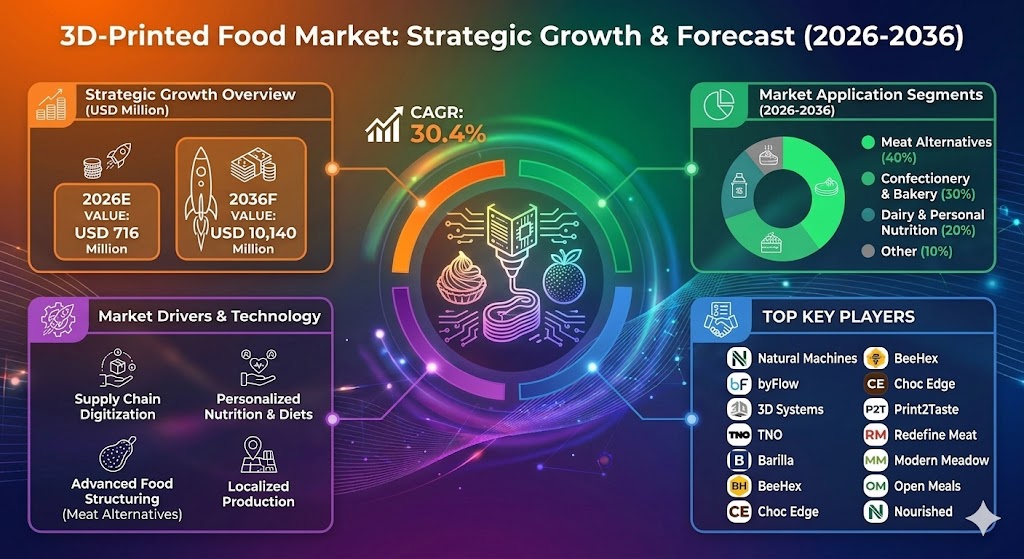
ROCKVILLE, MD, UNITED STATES, April 9, 2026 /EINPresswire.com/ -- According to Fact MR, latest analysis, the global 3D-printed food market is entering a transformative growth phase, valued at USD 530 million in 2025 and projected to reach USD 716 million in 2026. According to market analysis, the industry is expected to surge to USD 10,140 million by 2036, expanding at a robust CAGR of 30.4% and creating an incremental opportunity of USD 9,424 million.This growth reflects a structural shift from traditional food processing toward digitally controlled, customized food production, driven by precision nutrition, automation, and innovative culinary applications.
Get detailed market forecasts, competitive benchmarking, and pricing trends: https://www.factmr.com/connectus/sample?flag=S&rep_id=14664
Quick Stats
Market Size (2025): USD 530 million
Market Size (2026): USD 716 million
Forecast Value (2036): USD 10,140 million
CAGR (2026–2036): 30.4%
Incremental Opportunity: USD 9,424 million
Leading Segment: Commercial Foodservice (51% share)
Leading Technology: Extrusion-Based Printing (46% share)
Leading Region: Asia-Pacific
Key Players: 3D Systems, Natural Machines, byFlow, TNO, Redefine Meat
Executive Insight for Decision Makers
The market is transitioning from experimental applications to commercial-scale deployment, particularly in hospitality and healthcare nutrition.
Strategic Shift: From mass production to mass customization of food
What to Do:
Invest in printable ingredient R&D
Integrate digital workflows for scalable production
Focus on regulatory compliance and food safety
Risk of Inaction: Companies risk losing competitiveness as automation and personalization redefine food value chains
Market Dynamics
Key Growth Drivers
Increasing demand for personalized and functional nutrition
Expansion of digital food fabrication technologies
Rising adoption in healthcare for texture-modified diets
Premium foodservice demand for aesthetic and geometric food presentation
Key Restraints
High capital cost of 3D food printers
Limited production speed compared to conventional methods
Regulatory and consumer acceptance challenges
Emerging Trends
Integration of AI-driven food design systems
Growth in alternative protein printing
Development of multi-material food cartridges
Expansion of automated smart kitchens
Segment Analysis
Leading Segment: Commercial foodservice holds ~51% share, driven by restaurants and catering services adopting automated plating solutions
Fastest-Growing Segment: Healthcare nutrition, due to demand for precision diets
Breakdown:
Technology: Extrusion-based printing dominates (46%)
Applications: Bakery, confectionery, and customized nutrition
End Users: Restaurants, hospitals, research institutions
Strategic Importance: Segments enabling customization and repeatability are critical for scaling adoption.
Supply Chain Analysis (Who Supplies Whom)
Raw Material Suppliers: Food ingredient companies providing chocolate, dough, protein pastes, and gels
Manufacturers: Companies like 3D Systems and Natural Machines producing food printers and cartridges
Technology Integrators: Software developers enabling design and automation workflows
Distributors: Specialized equipment distributors and B2B food tech providers
End-Users:
Restaurants (customized dishes)
Hospitals (texture-modified nutrition)
Food manufacturers (R&D and premium products)
Flow: Ingredient suppliers → Printer manufacturers → Foodservice operators → End consumers
Pricing Trends
Pricing follows a premium model due to customization
Influenced by:
Ingredient formulation complexity
Equipment cost and maintenance
Regulatory compliance
Margins: Higher in niche applications (healthcare, premium dining), lower in mass-scale adoption
Regional Analysis
Top Countries by CAGR (2026–2036):
China – 32.5%
United States – 29.8%
Japan – 28.4%
Germany – 27.6%
United Kingdom – 26.9%
Regional Insights:
Asia-Pacific: Fastest growth due to automation investments and food tech adoption
North America: Innovation hub with strong commercialization
Europe: Research-driven market with strict regulatory frameworks
Developed vs Emerging:
Developed markets focus on technology refinement
Emerging markets drive volume growth and adoption
Competitive Landscape
Market Structure: Moderately fragmented
Key Players:
Natural Machines
byFlow
3D Systems
TNO
Redefine Meat
Print2Taste
BeeHex
Choc Edge
Open Meals
Nourished
Strategies:
Innovation in ingredient formulations
Expansion of printer capabilities
Strategic partnerships with foodservice providers
Focus on scalability and cost optimization
Strategic Takeaways
For Manufacturers:
Invest in scalable printing technologies
Develop multi-compatible ingredient systems
For Investors:
Target high-growth niches like healthcare nutrition and alternative proteins
For Marketers/Distributors:
Emphasize customization and premium experience
Build partnerships with hospitality chains
Future Outlook
The market is poised for mainstream commercialization, driven by:
AI-enabled food design
Sustainable ingredient innovation
Integration with smart kitchens and robotics
Long-term, 3D-printed food will redefine how food is produced, personalized, and consumed globally.
Conclusion
The global 3D-printed food market represents a paradigm shift from conventional food manufacturing to digitally enabled, precision-driven production systems. Companies that embrace innovation, scalability, and customization will unlock significant growth opportunities in this rapidly evolving landscape.
Why This Market Matters
3D food printing is not just a technological novelty—it is a strategic enabler of personalized nutrition, sustainable food systems, and next-generation culinary experiences, making it a critical focus area for future-ready businesses.
Unlock 360° insights for strategic decision making and investment planning: https://www.factmr.com/checkout/14664
To View Related Report:
3-in-1 Beverage Market https://www.factmr.com/report/3-in-1-beverage-market
Canned Fruits Market https://www.factmr.com/report/canned-fruits-market
Kosher Beef Market https://www.factmr.com/report/kosher-beef-market
Cheese Market https://www.factmr.com/report/138/cheese-market
About Fact.MR
Fact.MR is a global market research and consulting firm, trusted by Fortune 500 companies and emerging businesses for reliable insights and strategic intelligence. With a presence across the U.S., UK, India, and Dubai, we deliver data-driven research and tailored consulting solutions across 30+ industries and 1,000+ markets. Backed by deep expertise and advanced analytics, Fact.MR helps organizations uncover opportunities, reduce risks, and make informed decisions for sustainable growth.
S. N. Jha
Fact.MR
+ +1 628-251-1583
sales@factmr.com
Legal Disclaimer:
EIN Presswire provides this news content "as is" without warranty of any kind. We do not accept any responsibility or liability for the accuracy, content, images, videos, licenses, completeness, legality, or reliability of the information contained in this article. If you have any complaints or copyright issues related to this article, kindly contact the author above.
